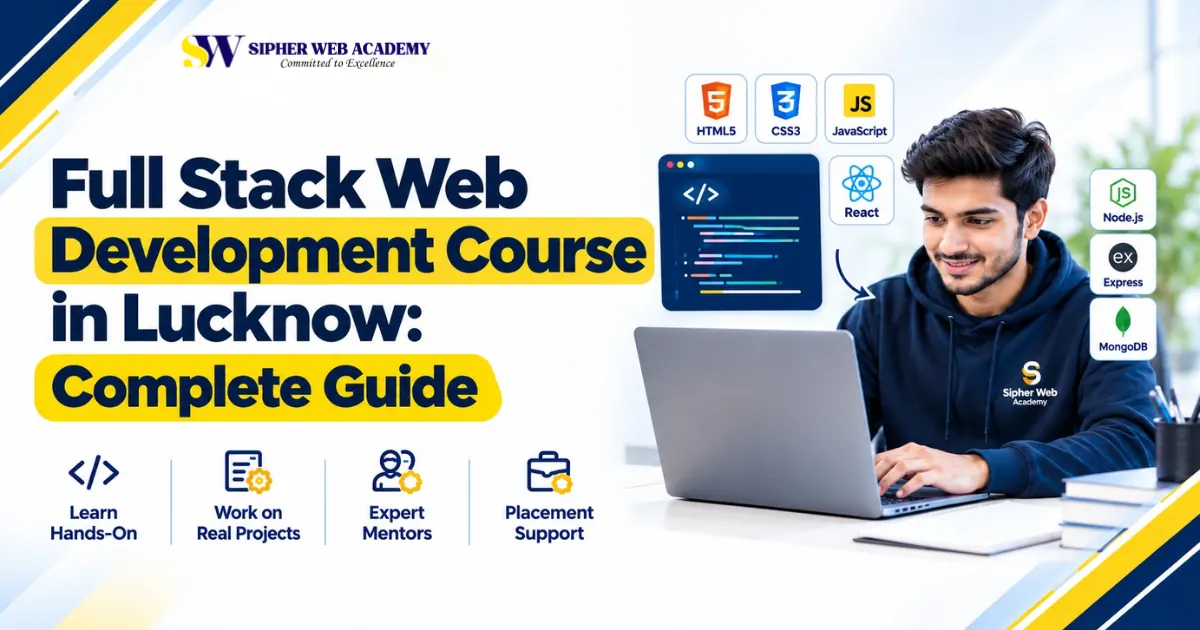
Join the Best Full Stack Web Development Course in Lucknow at Sipher Web Academy. Learn through live projects, expert guidance, and interview preparation.
On This Page
Full Stack Web Development Course in Lucknow: Complete Guide
The Best Full Stack Web Development Course in Lucknow helps students learn front-end and back-end development, work on real projects, and prepare for developer roles. The Sipher Web Academy provides a six-month course at Rs 20,000, with support from senior software developers, real projects, clarification classes, interactions with HR, and interviews.
What Is Full Stack Web Development?
Full stack web development involves building both the front end and back end of a website or web application. The front end is the part users see and interact with, while the back end manages application logic, data, and server-side operations.
A full stack developer understands how these parts work together. Learning web technologies, databases, APIs, and project development can help students build practical skills for software development careers.
Best Full Stack Web Development Course in Lucknow at Sipher Web Academy
Sipher Web Academy provides practical training for learners who want to understand website development and application building. The course combines technical learning with project work and career preparation.
Students receive guidance from a senior software developer and can ask questions during doubt-clearing sessions. The training also includes HR interaction and interview preparation to help learners understand recruitment expectations.
Course Details
- Course: Full Stack Web Development
- Duration: 6 Months
- Fee: ₹20,000
- Trainer: Senior Software Developer
- Practical Learning: Real live projects
- Additional Support: Doubt-clearing sessions, HR interaction, and interview preparation
Contact the academy to confirm the current batch schedule and detailed syllabus before registering.
What Will You Learn?
A full stack development curriculum generally covers the following areas. The exact technologies and modules should be confirmed with the academy.
1. HTML and CSS
Learn to structure web pages with HTML and style them with CSS. Topics may include page layouts, forms, navigation, responsive design, and creating websites that work across different screen sizes.
2. JavaScript
Understand variables, functions, conditions, loops, arrays, objects, and event handling. JavaScript helps make websites interactive and introduces the programming concepts needed for more advanced development.
3. Front-End Development
Learn how to organise website components and create user-friendly interfaces. Depending on the syllabus, this section may include a front-end framework such as React.
4. Back-End Development
Explore server-side programming, application logic, routing, and APIs. These skills help connect the user interface with databases and other services.
5. Database Management
Learn how applications store, retrieve, and manage information. Database concepts and practical queries help developers work with user accounts, products, posts, and other application data.
6. Full Stack Integration
Bring the front end, back end, and database together to build a functional application. This stage focuses on understanding how different components communicate and how to identify common errors.
Six-Month Full Stack Development Course Roadmap
The following is a suggested learning sequence. Confirm the final module-by-module schedule with Sipher Web Academy.
- Month 1: HTML, CSS, website structure, and responsive design.
- Month 2: JavaScript fundamentals and interactive web pages.
- Month 3: Front-end development and framework concepts, according to the syllabus.
- Month 4: Back-end programming, server-side logic, and APIs.
- Month 5: Database integration and full stack application development.
- Month 6: Live project work, testing, project improvement, and interview preparation.
This sequence moves from basic web concepts to application development. Students should practise regularly and complete exercises between sessions to strengthen their understanding.
Why Build Projects During Training?
Practical work gives students a chance to apply concepts instead of relying only on theory. Under the course structure, learners work on real projects with trainer guidance.
Project ideas commonly used in full stack learning include:
- Portfolio Website: Present skills, projects, and professional information.
- Task Management Application: Practise creating, updating, and managing tasks.
- Blog Website: Work with content, forms, and database operations.
- E-Commerce Application: Explore product listings, user interactions, and data management.
The actual projects depend on the course syllabus. Students can also use completed work to demonstrate their development skills during interviews.
Doubt-Clearing and Interview Preparation
Programming often requires practice and troubleshooting. Doubt-clearing sessions give students an opportunity to discuss difficult concepts and understand errors in their code.
The course also includes HR interaction and interview preparation. These activities can help learners practise explaining their projects, revising technical concepts, and becoming more familiar with recruitment conversations. Outcomes depend on individual preparation, skills, and employer requirements.
Career Opportunities After Full Stack Training
After developing suitable skills and project experience, learners may explore entry-level opportunities such as:
- Junior Full Stack Developer
- Front-End Developer
- Back-End Developer
- Web Developer
- Junior Software Developer
Job requirements vary between employers. Building a portfolio, practising coding problems, and understanding the technologies listed in job descriptions can help students prepare for applications.
Who Can Join This Course?
The course may suit college students, fresh graduates, beginners interested in coding, and learners who want to develop practical web development skills. Basic computer knowledge can be helpful, while consistent practice is important for progress.
Before joining, ask about eligibility, class timings, the complete syllabus, practical assignments, and any prerequisites.
Frequently Asked Questions
1. What is the duration of the Full Stack Web Development Course in Lucknow?
Sipher Web Academy offers a six-month Full Stack Web Development Course in Lucknow, combining technical training, practical projects, and developer guidance.
2. What is the course fee?
The Full Stack Web Development Course at Sipher Web Academy in Lucknow costs ₹20,000. Contact the academy to confirm current fees and payment options.
3. Can beginners learn full stack development?
Yes, beginners can learn full stack development by starting with HTML, CSS, and programming fundamentals, then building practical skills through guided projects and regular coding practice.
4. Does the course include live projects?
Sipher Web Academy’s Full Stack Web Development Course in Lucknow includes real live projects, helping students apply coding concepts and gain practical development experience.
5. Is interview preparation included?
Sipher Web Academy provides HR interaction and interview preparation to help Full Stack Web Development students practise recruitment skills and prepare for job interviews.
Register for Full Stack Web Development Training in Lucknow
Build your web development skills through structured learning, practical projects, and guidance from a senior software developer. If you are looking for the Best Full Stack Web Development Course in Lucknow, contact Sipher Web Academy to discuss the syllabus, batch availability, and registration process.
Ready to start learning? Register your interest today.

DR. IRFAN KHAN
Senior Mentor at SipherWeb Academy.
Comments (0)
Leave a Reply